Composer
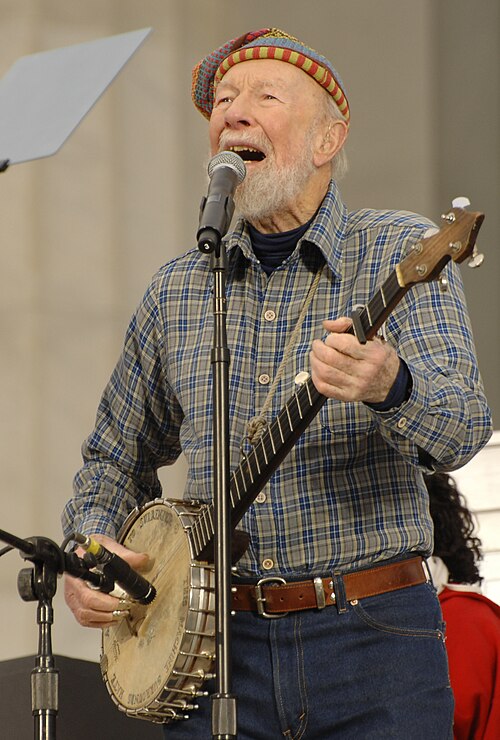
Pete Seeger
American folk singer (1919–2014)
1919–2014
201 works and musical collections
- Born
- 1919
- Died
- 2014
- Birthplace
- New York City
- Place of death
- Manhattan
- Citizenship / historical state
- United States
- Period (estimated from birth year)
- Modern
Biography
Peter Seeger (May 3, 1919 – January 27, 2014) was an American singer, songwriter, musician, and social activist. He was a fixture on nationwide radio in the 1940s, and had a string of hit records in the early 1950s as a member of The Weavers, especially their recording of Lead Belly's "Goodnight, Irene", which topped the charts for 13 weeks in 1950. Members of the Weavers were blacklisted during the McCarthy Era. In the 1960s, Seeger re-emerged on the public scene as a prominent singer of protest music in support of international disarmament, civil rights, workers' rights, counterculture, environmental causes, and ending the Vietnam War.
Among the prolific songwriter's best-known songs are "Where Have All the Flowers Gone?" (with additional lyrics by Joe Hickerson), "If I Had a Hammer (The Hammer Song)" (with Lee Hays of the Weavers), "Kisses Sweeter than Wine" (also with Hays), and "Turn! Turn! Turn! (To Everything There Is a Season)", which has been recorded by many artists in and outside the folk revival movement. "Flowers" was a hit recording for The Kingston Trio (1962); Marlene Dietrich, who recorded it in English, German and French (1962); and Johnny Rivers (1965). "If I Had a Hammer" was a hit for Peter, Paul and Mary (1962) and Trini Lopez (1963) while The Byrds had a number one hit with "Turn! Turn! Turn!" in 1965.
Seeger was one of the folk singers responsible for popularizing the spiritual "We Shall Overcome" (also recorded by Joan Baez and many other singer-activists), which became the acknowledged anthem of the civil rights movement, soon after folk singer and activist Guy Carawan introduced it at the founding meeting of the Student Nonviolent Coordinating Committee (SNCC) in 1960. In the PBS American Masters episode "Pete Seeger: The Power of Song", Seeger said it was he who changed the lyric from the traditional "We will overcome" to the more singable "We shall overcome".
Biography excerpt from Wikipedia contributors, available under CC BY-SA 4.0. Formatting and reference markers have been removed; the introduction may be shortened. View contributors and article history.
Life and musical career
- Selected occupations
- singer; street artist; banjoist; musicologist; singer-songwriter; guitarist; peace activist; mandolinist; recording artist; folk musician; composer; musician
- Education
- Harvard University; Avon Old Farms School
- Recorded memberships
- The Weavers
- Genres
- traditional folk music
- Notable works
- Where Have All the Flowers Gone?
- Awards
- National Medal of Arts; Grammy Lifetime Achievement Award; War Resisters League Peace Award; Library of Congress Living Legend; Kennedy Center Honors; Paul Robeson Award; Schneider Family Book Award; Eugene V. Debs Award; Rock and Roll Hall of Fame
- Official website
- http://www.peteseeger.net/
- Birth name
- Peter Seeger
- Languages used
- English
- VIAF ID
- 27248780
- ISNI
- 0000000114891893
- GND ID
- 11925557X
- Library of Congress ID
- n50006375
- MusicBrainz ID
- af18a9bc-e4ab-4068-9489-b64e8186fcf1
Recorded in Wikidata. Affiliations may refer to earlier stages of the composer's career.
In this catalogue
- Common listed instruments
- Guitar, Piano, Choir, Voice, Vocal
- Genres represented
- Folk, Australian, Classical, easy listening, Jazz
- Source entries with composition dates
- 0
These details describe the indexed sheet music, including arrangements.
Catalogue
Sheet music catalogue page 5 of 5
Instruments describe listed editions, including arrangements. Composition dates and keys appear where recorded; collection pages show their individual contents.
| Title | Work details | Listed instruments | Sheet music |
|---|---|---|---|
| Viva La Quince Brigada | See work details | See edition details | View sheet music |
| Wasn't That a Time | See work details | See edition details | View sheet music |
| Way Out There | See work details | See edition details | View sheet music |
| What Month Was My Jesus Born In | See work details | See edition details | View sheet music |
| Wimoweh | See work details | See edition details | View sheet music |
| Windy Old Weather | See work details | See edition details | View sheet music |
| Woody's Rag | See work details | See edition details | View sheet music |
| Won't You go Down, Old Hannah | See work details | See edition details | View sheet music |
| Worried Man Blues | See work details | See edition details | View sheet music |
Biographical record: Wikidata, matched on name and checked against dates held in the catalogue. The period label is an estimate from birth year. Authority record: VIAF 27248780. Portrait: Donna Lou Morgan, U.S. Navy, Public domain, via Wikimedia Commons.