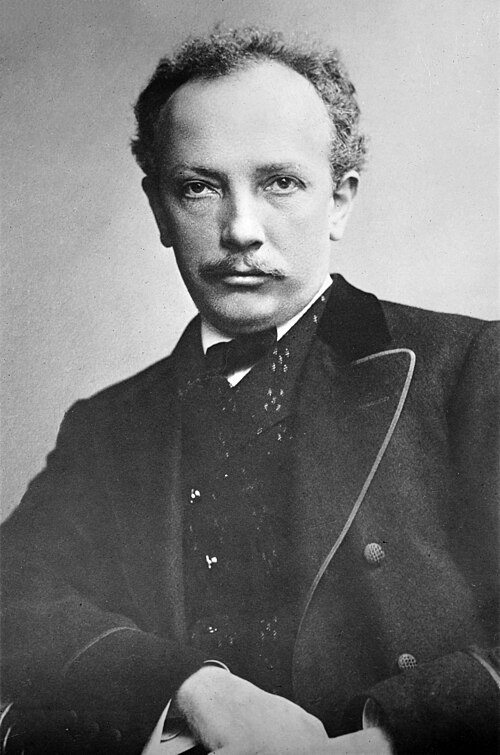
Composer
Richard Strauss
German composer and orchestra director (1864–1949)
1864–1949
7 musical collections
- Born
- 1864
- Died
- 1949
- Birthplace
- Munich
- Place of death
- Garmisch-Partenkirchen
- Citizenship / historical state
- Germany
- Period (estimated from birth year)
- Modern
Biography
Richard Georg Strauss (; German: [ˈʁɪçaʁt ˈʃtʁaʊs] ; 11 June 1864 – 8 September 1949) was a German composer and conductor known for his tone poems and operas. He was a leading figure of the late Romantic and early Modern era.
His first tone poem to achieve wide acclaim was Don Juan. This was followed by other lauded works of this kind, including Death and Transfiguration, Till Eulenspiegel's Merry Pranks, Also sprach Zarathustra, Don Quixote, Ein Heldenleben, Symphonia Domestica, and An Alpine Symphony. His first opera to achieve international fame was Salome. This was followed by Elektra, Der Rosenkavalier, Ariadne auf Naxos, Die Frau ohne Schatten, Die ägyptische Helena, Arabella, Daphne, Friedenstag, Die Liebe der Danae and Capriccio. Other well-known works by Strauss include two symphonies, lieder (especially the Four Last Songs), the Violin Concerto in D minor, the Horn Concertos Nos. 1 and 2, his Oboe Concerto, and other instrumental works such as Metamorphosen.
A prominent conductor in Western Europe and the Americas, Strauss enjoyed quasi-celebrity status as his compositions became standards of orchestral and operatic repertoire. He was chiefly admired for his interpretations of the works of Liszt, Mozart, and Wagner in addition to his own works. A conducting disciple of Hans von Bülow, Strauss began his conducting career as Bülow's assistant with the Meiningen Court Orchestra in 1883. After Bülow resigned in 1885, Strauss served as that orchestra's primary conductor for five months before being appointed to the conducting staff of the Bavarian State Opera. He served as principal conductor of the Deutsches Nationaltheater und Staatskapelle Weimar from 1889 to 1894. In 1894 he made his conducting debut at the Bayreuth Festival. He returned to the Bavarian State Opera before becoming principal conductor of the Berlin State Opera and then the Vienna State Opera. In 1920 he co-founded the Salzburg Festival.
In 1933 Strauss was appointed to two important musical positions in Nazi Germany: head of the Reichsmusikkammer and principal conductor of the Bayreuth Festival. These positions have led some to criticize Strauss for his seeming collaboration with the Nazis. However, Strauss's daughter-in-law was Jewish, and much of his apparent acquiescence to the Nazi Party was done to save her life and the lives of her children. He was also apolitical, and took the Reichsmusikkammer post to advance copyright protections for composers, attempting as well to preserve performances of works by banned composers. Further, Strauss insisted on using a Jewish librettist, Stefan Zweig, for his opera Die schweigsame Frau which ultimately led to his firing from the Reichsmusikkammer and Bayreuth in 1935, just two years after his appointment. Strauss's opera Friedenstag, which premiered just before the outbreak of World War II, was a thinly veiled criticism of the Nazi Party that attempted to persuade Germans to abandon violence for peace. Thanks to his influence, his daughter-in-law was placed under protected house arrest during the war, but despite extensive efforts he was unable to save dozens of his in-laws from being killed in Nazi concentration camps. In 1948, a year before his death, he was cleared of any wrongdoing by a denazification tribunal in Munich.
Biography excerpt from Wikipedia contributors, available under CC BY-SA 4.0. Formatting and reference markers have been removed; the introduction may be shortened. View contributors and article history.
Life and musical career
- Occupations
- composer; conductor; librettist; musician; general music director
- Recorded memberships
- Bavarian Academy of Fine Arts
- Instruments played
- piano
- Genres
- opera; symphony; classical music; sardana
- Notable works
- Also sprach Zarathustra; Salome; Der Rosenkavalier; Ariadne auf Naxos; Elektra
- Selected awards
- Pour le Mérite for Sciences and Arts order; honorary citizen of Munich; Bavarian Maximilian Order for Science and Art; Royal Philharmonic Society Gold Medal; honorary citizen of Vienna; Order of the Redeemer; Adlerschild des Deutschen Reiches; Order of the Iron Crown (Austria); Order of the Dannebrog; Commander of the Order of Orange-Nassau; Order of the Oak Crown; Order of Saint-Charles
- Birth name
- Richard Georg Strauss
- Languages used
- German
- VIAF ID
- 24796264
- ISNI
- 0000000120999614; 0000000029864532
- GND ID
- 11861911X
- Library of Congress ID
- n79041680
- MusicBrainz ID
- 4cb43d82-824e-4034-b03d-1a98f36f6e16
Recorded in Wikidata. Affiliations may refer to earlier stages of the composer's career.
In this catalogue
- Common listed instruments
- Voice, Piano, Low Voice, Horn, Voice High
- Genres represented
- Classical
- Source entries with composition dates
- 54
These details describe the indexed sheet music, including arrangements.
Catalogue
Musical collections
Instruments describe listed editions, including arrangements. Composition dates and keys appear where recorded; collection pages show their individual contents.
| Title | Work details | Listed instruments | Sheet music |
|---|---|---|---|
| Musical collection Songs, Op. 56 |
| Check individual editions | View collection |
| Musical collection Songs, Op. 69 |
| Check individual editions | View collection |
| Musical collection Songs, Op. 10 |
| Check individual editions | View collection |
| Musical collection Songs, Op. 68 |
| Check individual editions | View collection |
| Musical collection Songs, Op. 15 |
| Check individual editions | View collection |
| Musical collection Songs, Op. 17 |
| Check individual editions | View collection |
| Musical collection Songs, Op. 19 |
| Check individual editions | View collection |
Biographical record: Wikidata, matched on name and checked against dates held in the catalogue. The period label is an estimate from birth year. Authority record: VIAF 24796264. Portrait: unidentified photograph, Public domain, via Wikimedia Commons.