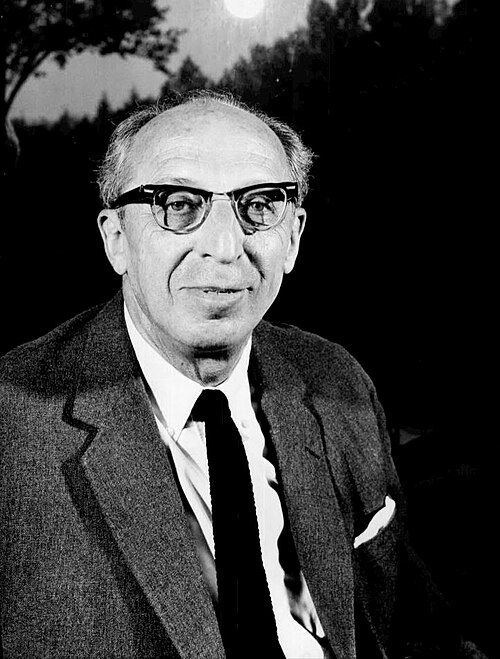
Composer
Aaron Copland
American composer, composition teacher, writer, and conductor (1900-1990)
1900–1990
146 works and musical collections
- Born
- 1900
- Died
- 1990
- Birthplace
- Brooklyn
- Place of death
- Sleepy Hollow
- Citizenship / historical state
- United States
- Period (estimated from birth year)
- Modern
Biography
Aaron Copland ( KOHP-lənd; November 14, 1900 – December 2, 1990) was an American composer, critic, writer, teacher, pianist, and conductor of his own and other American music. Copland was referred to by his peers and critics as the "Dean of American Music". The open, slowly changing harmonies in much of his music are typical of what many consider the sound of American music, evoking the vast American landscape and pioneer spirit. He is best known for the works he wrote in the 1930s and 1940s in a deliberately accessible style often referred to as "populist" and which he called his "vernacular" style. Works in this vein include the ballets Appalachian Spring, Billy the Kid and Rodeo, his Fanfare for the Common Man and Third Symphony. In addition to his ballets and orchestral works, he produced music in many other genres, including chamber music, vocal works, opera, and film scores.
After some initial studies with composer Rubin Goldmark, Copland traveled to Paris, where he first studied with Isidor Philipp and Paul Vidal, then with noted pedagogue Nadia Boulanger. He studied three years with Boulanger, whose eclectic approach to music inspired his own broad taste. Determined upon his return to the U.S. to make his way as a full-time composer, Copland gave lecture-recitals, wrote works on commission and did some teaching and writing. But he found that composing orchestral music in a modernist style, which he had adopted while studying abroad, was unprofitable, particularly in light of the Great Depression. He shifted in the mid-1930s to a more accessible musical style that mirrored the German idea of Gebrauchsmusik ("music for use"), music that could serve utilitarian and artistic purposes. During the Depression years, he traveled extensively to Europe, Africa, and Mexico, formed an important friendship with Mexican composer Carlos Chávez, and began composing his signature works.
During the late 1940s, Copland became aware that Stravinsky and other fellow composers had begun to study Arnold Schoenberg's use of twelve-tone (serial) techniques. After he had been exposed to the works of French composer Pierre Boulez, he incorporated serial techniques into his Piano Quartet (1950), Piano Fantasy (1957), Connotations for orchestra (1961), and Inscape for orchestra (1967). Unlike Schoenberg, Copland used his tone rows in much the same fashion as his tonal material—as sources for melodies and harmonies, rather than as complete statements in their own right, except for crucial events from a structural point of view. From the 1960s onward, Copland's activities turned more from composing to conducting. He became a frequent guest conductor of orchestras in the U.S. and the UK and made a series of recordings of his music, primarily for Columbia Records.
Biography excerpt from Wikipedia contributors, available under CC BY-SA 4.0. Formatting and reference markers have been removed; the introduction may be shortened. View contributors and article history.
Life and musical career
- Occupations
- conductor; pianist; composer; choreographer; musicologist; music educator; jazz musician; film score composer; music critic
- Teachers
- Nadia Boulanger; Rubin Goldmark
- Recorded memberships
- American Academy of Arts and Letters; American Academy of Arts and Sciences; National Academy of Fine Arts (Argentina)
- Instruments played
- piano
- Genres
- opera; symphony; classical music; ballet
- Selected awards
- Guggenheim Fellowship; Academy Award for Best Original Dramatic or Comedy Score; Rome Prize; National Medal of Arts; Handel Medallion; Presidential Medal of Freedom; Charles E. Lutton Man of Music Award; Kennedy Center Honors; Grammy Trustees Award; Pulitzer Prize for Music; Congressional Gold Medal; Fulbright Scholarship
- Official website
- https://www.aaroncopland.com/
- Birth name
- Aaron Copland
- Languages used
- English
- VIAF ID
- 51874819
- ISNI
- 0000000120961237
- GND ID
- 118986481
- Library of Congress ID
- n79089419
- MusicBrainz ID
- aad3af83-5b59-4b86-a569-1a8409149b09
Recorded in Wikidata. Affiliations may refer to earlier stages of the composer's career.
In this catalogue
- Common listed instruments
- Piano, Low Voice, violin, Flute, Cello
- Genres represented
- Classical, American, Religious
- Source entries with composition dates
- 5
These details describe the indexed sheet music, including arrangements.
Catalogue
Sheet music catalogue page 1 of 4
Instruments describe listed editions, including arrangements. Composition dates and keys appear where recorded; collection pages show their individual contents.
| Title | Work details | Listed instruments | Sheet music |
|---|---|---|---|
| Old American Songs, Set 1: No. 4, Simple Gifts | See work details |
12 more instruments
| View sheet music |
| Laurie's Song | See work details |
11 more instruments
| View sheet music |
| Old American Songs, Set 2: No. 4, At the River | See work details |
| View sheet music |
| Old American Songs, Set 2: No. 3, The Golden Willow Tree | See work details |
| View sheet music |
| The Cat and the Mouse | See work details |
| View sheet music |
| Old American Songs, Set 1: No. 3, Long Time Ago | See work details |
| View sheet music |
| Old American Songs, Set 2: No. 5, Ching-A-Ring Chaw | See work details |
11 more instruments
| View sheet music |
| Fanfare for the Common Man |
|
11 more instruments
| View sheet music |
| Ma's Song from The Tender Land | See work details |
| View sheet music |
| Old American Songs, Set 1: No. 1, The Boatmen's Dance | See work details |
| View sheet music |
| Down A Country Lane | See work details |
| View sheet music |
| Heart, We Will Forget Him | See work details |
| View sheet music |
| Sleep Is Supposed To Be | See work details |
| View sheet music |
| Ranch House Party | See work details |
| View sheet music |
| The sun is coming up from The Tender Land | See work details | See edition details | View sheet music |
| Ukelele Serenade | See work details |
| View sheet music |
| Jubilee Variation | See work details | See edition details | View sheet music |
| New England Countryside | See work details | See edition details | View sheet music |
| Proclamation | See work details | See edition details | View sheet music |
| Old American Songs, Set 2: No. 1, The Little Horses | See work details |
12 more instruments
| View sheet music |
| Piano Variations | See work details |
| View sheet music |
| Proclamation for Piano | See work details |
| View sheet music |
| I've Heard an Organ Talk Sometimes | See work details |
11 more instruments
| View sheet music |
| Why Do They Shut Me Out Of Heaven? | See work details |
1 more instruments
| View sheet music |
| Vocalise | See work details |
1 more instruments
| View sheet music |
| Billy and His Sweetheart | See work details |
11 more instruments
| View sheet music |
| Martin's Song from The Tender Land | See work details | See edition details | View sheet music |
| Queenie's Song from The Second Hurricane | See work details | See edition details | View sheet music |
| Nature, The Gentlest Mother | See work details |
| View sheet music |
| Waltz And Celebration | See work details |
| View sheet music |
| Old American Songs | See work details | See edition details | View sheet music |
| Clarinet Concerto |
|
| View sheet music |
| Grovers Corners | See work details | See edition details | View sheet music |
| Shaker Melody | See work details |
| View sheet music |
| Quiet City for Cor Anglais, Trumpet and Strings | See work details | See edition details | View sheet music |
| Old American Songs, Set 1: No. 2, The Dodger | See work details |
| View sheet music |
| Old American Songs, Set 2: No. 2, Zion's Walls | See work details |
11 more instruments
| View sheet music |
| Midsummer Nocturne | See work details |
| View sheet music |
| Four Piano Blues | See work details |
| View sheet music |
| In Evening Air | See work details |
| View sheet music |
| Piano Sonata |
|
| View sheet music |
| Midday Thoughts | See work details |
| View sheet music |
| There Came A Wind Like A Bugle | See work details |
| View sheet music |
| Pastorale | See work details |
| View sheet music |
| Buckaroo Holiday | See work details |
| View sheet music |
| Saturday Night Waltz | See work details |
| View sheet music |
| The Resting-Place On the Hill | See work details |
| View sheet music |
| Story of Our Town | See work details |
| View sheet music |
Biographical record: Wikidata, matched on name and checked against dates held in the catalogue. The period label is an estimate from birth year. Authority record: VIAF 51874819. Portrait: CBS Television, Public domain, via Wikimedia Commons.