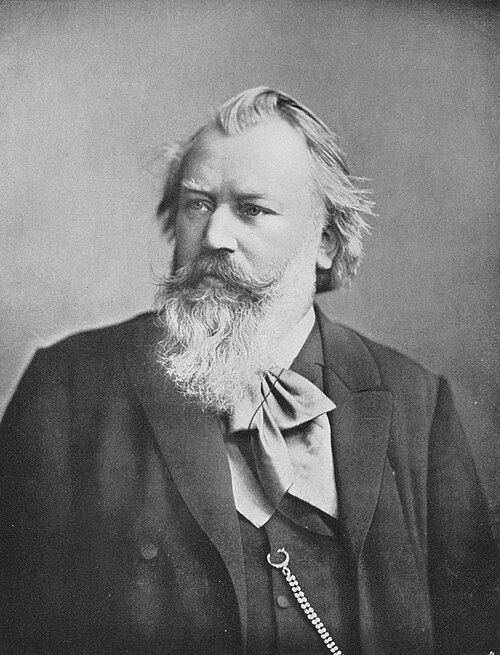
Composer
Johannes Brahms
1833–1897
4,957 works in the index
- Born
- 1833
- Died
- 1897
- Birthplace
- Hamburg
- Citizenship / historical state
- Hamburg
- Period (estimated from birth year)
- Romantic
Biography
Brahms wrote densely and revised ruthlessly, destroying what did not satisfy him, so the surviving catalogue is smaller than his contemporaries' and uniformly serious. It covers symphonies, concerti, a large body of chamber music, songs and late piano pieces.
For pianists the late Op. 116–119 pieces are the heart of it — short, inward and technically less punishing than the earlier sonatas, though musically demanding. The Hungarian Dances in their four-hand form are the most-played thing he wrote and are genuinely approachable. Singers have over two hundred songs and the German Requiem.
His piano writing assumes a large hand and comfortable tenths appear regularly. Editions differ little; what varies is fingering, and an edition with good fingering is worth paying for here.
In this catalogue
- Common listed instruments
- Piano, Voice, Choir, Low Voice, Orchestra
- Genres represented
- Classical, Jazz, pop, Pop, Christmas
- Works with composition dates
- 255 of 4,957
These details describe the indexed sheet music, including arrangements.
Catalogue
Works page 20 of 104
Years are composition dates where known. Instruments describe editions in our catalogue and may include arrangements. A dash means the detail is not recorded.
| Work | Year composed | Catalogue / opus | Key in title | Listed instruments | Genre | Editions |
|---|---|---|---|---|---|---|
| Ein Deutsches Requiem , Op. 45 - 2. Denn ales Fleisch, es ist wie Gras Performed by Johannes Brahms | 1865–68IMSLP | Op. 45 | — | Voice, Choir | Classical | 4 |
| Sonata No. 2 in F Major, Op. 99 | 1886IMSLP | Op. 99 | F major | Cello | Classical | 5 |
| Piano Concerto No. 1 in D Minor, Op. 15 - Third Movement | — | Op. 15 | D minor | — | Classical | 5 |
| Wo Ist Ein So Herrlich Volk Op.109 No.3 | — | Op.109 No.3 | — | Choir | Classical | 4 |
| Symphony No. 3 in F Major (3rd movement | — | — | F major | — | Classical | 2 |
| Four Quartets, Op. 92, No. 4: Warum? | — | Op. 92, No. 4 | — | Piano | Classical | 2 |
| Six Songs, op. 6, no. 2, Der Frühling | — | op. 6, no. 2 | — | Piano, Voice | Classical | 4 |
| Fifty-One Exercises, Nos. 26 - 51 | — | — | — | — | Classical | 2 |
| Four Songs, Op. 46 | — | Op. 46 | — | Piano, Voice | Classical | 3 |
| Nine Songs, Op. 63 | — | Op. 63 | — | Piano, Voice | Classical | 3 |
| Three Hungarian Dances - Score and Parts | — | — | — | — | Classical | 3 |
| Three Quartets, Op.64, No.3 Fragen | — | Op.64, No.3 | — | Piano | Classical | 2 |
| Eight Songs, Op. 58 | — | Op. 58 | — | Piano, Voice | Classical | 3 |
| Ach, wende diesem Blick - Score | — | — | — | Piano | Classical | 2 |
| Brahms: Intermezzi, Rhapsody, Op. 119 | — | Op. 119 | — | Piano | Classical | 4 |
| Waltz Op.39 No.15 | 1865Wikidata | Op.39 No.15 | — | Piano | — | 4 |
| Concerto for Piano and Orchestra no. 1 in D minor, op. 15: III. Rondo. Allegro non troppo | — | op. 15 | D minor | Piano | Classical | 2 |
| Hungarian Dances for orchestra, WoO 1, Book 1, no. 1 in G minor: Allegro molto | — | WoO 1 | G minor | Piano | Classical, Pop | 6 |
| Hungarian Dances for orchestra, WoO 1, Book 4, no. 20 in E minor: Poco allegretto - Vivace | — | WoO 1 | E minor | Guitar | Classical | 4 |
| Hungarian Dances for piano, 4 hands, WoO 1, Book 2, No. 9 in E minor: Allegro ma non troppo | — | WoO 1 | E minor | Piano | Classical | 4 |
| Schaffe in mir, Gott | — | — | — | Choir | Classical | 4 |
| Cello Sonata No.1 | 1862–65IMSLP | — | — | Piano, Cello | Classical | 3 |
| Cello Sonata No.2 | 1886IMSLP | — | — | Piano, Cello | Classical | 2 |
| Chorale Prelude and Fugue on 'O Traurigkeit, o Herzeleid' | 1858 (Prelude), 1873 (Fugue)IMSLP | — | — | Organ | Classical | 4 |
| Clarinet Sonata No.1, Op.120/1 | 1894IMSLP | Op.120/1 | — | Piano, Clarinet | Classical | 3 |
| 49 Deutsche Volkslieder | 1893–94IMSLP | — | — | Piano | Classical | 3 |
| Fest- und Gedenksprüche | 1888–89?IMSLP | — | — | — | Classical | 3 |
| 8 Klavierstücke | 1871 (No.1), 1878 (Nos.2-8)IMSLP | — | — | — | Classical | 3 |
| 12 Songs and Romances | 1859–60IMSLP | — | — | — | Classical | 2 |
| 7 Lieder | 1853–68IMSLP | — | — | voice piano | Classical | 3 |
| Marienlieder | 1859–60IMSLP | — | — | — | Classical | 2 |
| Nänie | 1880–81IMSLP | — | — | Harp, Voice, Orchestra, Choir, Timpani, Tuba | Classical | 3 |
| Piano Concerto No.1 | 1854–59Wikidata | — | — | Cello, Orchestra, Horn, Timpani, Tuba | Classical | 3 |
| Piano Concerto No.2 | 1878–81IMSLP | — | — | Horn, Timpani, Tuba | Classical | 3 |
| Piano Quartet No.3 | 1855–75IMSLP | — | — | Piano, Cello, violin | Classical | 2 |
| Piano Quintet | 1864IMSLP | — | — | Piano, Cello | Classical | 3 |
| Piano Trio No.1 in B major | 1853–54 1st version1889 2nd versionIMSLP | — | B major | Piano, Cello, violin | Classical | 3 |
| 3 Quartets | 1859 (No.1), 1863 (Nos.2-3)IMSLP | — | — | Tenor, Voice Soprano, Alto | Classical | 3 |
| 6 Quartets | 1888 (Nos.1, 2), 1891 ca. (Nos.3-6)IMSLP | — | — | Tenor, Voice Soprano, Alto | Classical | 3 |
| Rinaldo | 1863–68IMSLP | — | — | Timpani | Classical | 3 |
| 15 Romances | 1861–69IMSLP | — | — | Piano | Classical | 2 |
| 4 Serious Songs | 1896IMSLP | — | — | — | Classical | 3 |
| 6 Songs | 1852–53IMSLP | — | — | — | Classical | 3 |
| Variations on a Hungarian Song | 1853–56 ca.IMSLP | — | — | Piano | Classical | 3 |
| Brahms Lullaby: Flut | — | — | — | — | — | 3 |
| Hungarian Dance No. 5: Cello Quarte | — | — | — | — | — | 3 |
| Waltz: Op.39, No.15 String Quarte | — | Op.39, No.15 | — | — | — | 3 |
| Rhapsody No. 1 in B minor: Op. 79, No. | — | Op. 79 | B minor | — | — | 3 |
Biographical record: Wikidata, matched on name and checked against dates held in the catalogue. The period label is an estimate from birth year. The biography above is our own. Authority record: VIAF 7573295. Portrait: C. Brasch , Berlin ( biography ), Public domain, via Wikimedia Commons.