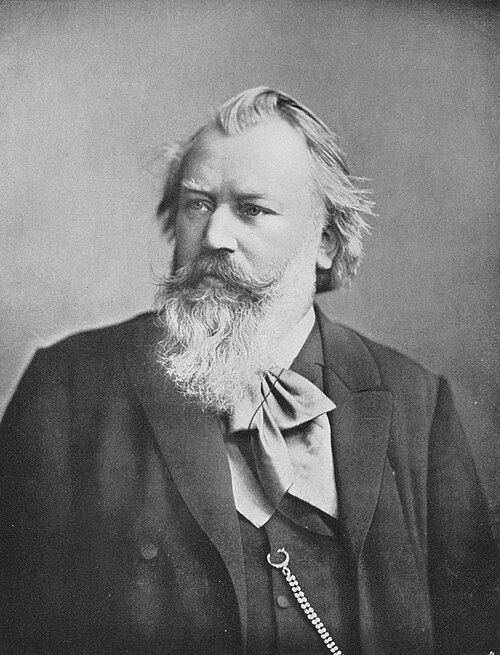
Composer
Johannes Brahms
1833–1897
4,957 works in the index
- Born
- 1833
- Died
- 1897
- Birthplace
- Hamburg
- Citizenship / historical state
- Hamburg
- Period (estimated from birth year)
- Romantic
Biography
Brahms wrote densely and revised ruthlessly, destroying what did not satisfy him, so the surviving catalogue is smaller than his contemporaries' and uniformly serious. It covers symphonies, concerti, a large body of chamber music, songs and late piano pieces.
For pianists the late Op. 116–119 pieces are the heart of it — short, inward and technically less punishing than the earlier sonatas, though musically demanding. The Hungarian Dances in their four-hand form are the most-played thing he wrote and are genuinely approachable. Singers have over two hundred songs and the German Requiem.
His piano writing assumes a large hand and comfortable tenths appear regularly. Editions differ little; what varies is fingering, and an edition with good fingering is worth paying for here.
In this catalogue
- Common listed instruments
- Piano, Voice, Choir, Low Voice, Orchestra
- Genres represented
- Classical, Jazz, pop, Pop, Christmas
- Works with composition dates
- 255 of 4,957
These details describe the indexed sheet music, including arrangements.
Catalogue
Works page 3 of 104
Years are composition dates where known. Instruments describe editions in our catalogue and may include arrangements. A dash means the detail is not recorded.
| Work | Year composed | Catalogue / opus | Key in title | Listed instruments | Genre | Editions |
|---|---|---|---|---|---|---|
| Eight Pieces (Klavierstucke), Op. 76: 2. Capriccio, B Minor | — | Op. 76 | — | Piano | Classical | 9 |
| Eight Pieces (Klavierstucke), Op. 76: 5. Capriccio, C# Minor | — | Op. 76 | — | Piano | Classical | 10 |
| Eight Pieces (Klavierstucke), Op. 76: 7. Intermezzo, A Minor | — | Op. 76 | — | Piano | Classical | 9 |
| Six Pieces (Klavierstucke), Op. 118: 2. Intermezzo, A Major | — | Op. 118 | — | Piano | Classical | 10 |
| Hungarian Dances Nos. 1, 3 & 10 (orch. Brahms) | 1858-68 (Nos.1-10); 1879 (Nos.11-21)IMSLP | — | — | Piano, Harp, Organ, Cello, Flute, Oboe, violin, Bassoon, Double Bass, Horn, Clarinet, Trombone, Timpani, Trumpet | Classical | 13 |
| 1. Den es gehet dem Menschen (C minor) | — | — | — | Voice | Classical | 11 |
| Blest Are They That Sorrow Bear | — | — | — | Piano | Classical | 10 |
| Brahms: Hungarian Dances, Volume II | — | — | — | Piano, Hands | Classical | 11 |
| Schicksalslied, op. 54 | 1868–71IMSLP | op. 54 | — | Piano, Cello, Flute, Oboe, violin, Bassoon, Orchestra, Double Bass, Horn, Clarinet, Trombone, Timpani, Trumpet, T | Classical | 9 |
| Geistliches Lied | 1856IMSLP | — | — | Organ, Choir | Classical | 7 |
| Piano Trio No.3 | 1886IMSLP | — | — | Piano, Cello, violin | Classical | 8 |
| Symphony No.3 | 1883IMSLP | — | — | Cello, violin, Horn, Timpani, Contrabassoon | Classical | 8 |
| 38. O kuhler Wald | — | — | — | Voice, Voice High, Low Voice | Classical | 13 |
| 39. O liebliche Wangen | — | — | — | Piano, Voice, Voice High, Low Voice | Classical | 16 |
| 51. Treue Liebe | — | — | — | Piano, Voice, Voice High, Low Voice | Classical | 15 |
| 57. Wie bist du meine Konigin | — | — | — | Voice, Voice High, Low Voice | Classical | 10 |
| 70. Rote Abendwolken | — | — | — | Voice, Choir | Classical | 9 |
| An eine Aeolsharfe | — | — | — | Piano, Voice High, Low Voice | Classical | 14 |
| How lovely is Thy dwelling (Brahms-Requiem) | — | — | — | Piano, Choir | Classical | 11 |
| Four Pieces (Klavierstucke), Op. 119: 1. Intermezzo, B Minor | — | Op. 119 | — | Piano | Classical | 10 |
| Four Pieces (Klavierstucke), Op. 119: 3. Intermezzo, C Major | — | Op. 119 | — | Piano | Classical | 10 |
| Hungarian Dances No. 17 - 21 (orch. Dvorak) | 1858-68 (Nos.1-10); 1879 (Nos.11-21)IMSLP | — | — | Piano, Cello, Flute, Oboe, violin, Bassoon, Double Bass, Horn, Clarinet, Trombone, Timpani, Trumpet, Tuba, Piccol | Classical | 8 |
| Die Mainacht (May Night) Brahms | 1857–1864IMSLP | — | — | Voice | Classical | 11 |
| Ii. Erlaube Mir (Allow Me) | — | — | — | Piano, Voice, Choir | Classical | 9 |
| Fragen | — | — | — | Voice, Choir | Classical | 10 |
| Klosterfraeulein | 1852–74IMSLP | — | — | Voice, Choir | Classical | 9 |
| Intermezzo a-moll, op. 118 | — | op. 118 | — | Piano, harpsichord | Classical | 10 |
| Intermezzo E major Op. 116, No. 4 | — | Op. 116, No. 4 | — | — | Classical | 11 |
| Violin Sonata No. 3 in D Minor (2nd movement | — | — | D minor | Piano | Classical | 8 |
| Brahms: Hungarian Dances, Volume I | — | — | — | Piano, Hands | Classical | 10 |
| Brahms: Variations on a Theme of Haydn, Op. 56B (Original) | — | Op. 56B | — | Piano, Hands | Classical | 10 |
| 6 Klavierstücke, op. 118: Nr. 4. Intermezzo in f-Moll. Allegretto un poco agitato | — | op. 118 | — | Piano | Classical | 8 |
| Ballades | 1854IMSLP | — | — | Piano | Classical | 9 |
| 3 Intermezzi | 1892IMSLP | — | — | Piano, harpsichord | Classical | 9 |
| Scherzo | 1851IMSLP | — | — | Piano, violin, Recorder, Viola | Classical | 10 |
| 2. Alte Liebe | — | — | — | Piano, Voice, Voice High, Low Voice | Classical | 14 |
| 24. Liebestreu | — | — | — | Piano, Voice, Voice High, Low Voice | Classical | 12 |
| 46. Serenade | — | — | — | Piano, Voice High, Low Voice | Classical | 5 |
| Die Kranze (The Garlands) | — | — | — | Piano, Voice, Low Voice | Classical | 9 |
| Kommt Dir Manchmal In Den Sinn (Do You Ever Now Remember) | — | — | — | Voice, Low Voice | Classical | 7 |
| Muss es eine Trennung geben | — | — | — | Piano, Voice, Low Voice | Classical | 8 |
| 1. Primo - VI Vivace | — | — | — | Piano | Classical | 9 |
| Lieber Gott (Brahms-Zigeunerlieder) | — | — | — | Voice, Choir | Classical | 9 |
| Roslein dreie(Brahms-Zigeunerlieder) | — | — | — | Voice, Choir | Classical | 8 |
| Weit und breit(Brahms-Zigeunerlieder) | — | — | — | Choir, Voice | Classical | 8 |
| How Lovely Is Thy Dwelling Place | — | — | — | Piano, Organ, Choir | Classical | 8 |
| He, Zigeuner, greife in die Saiten ein | — | — | — | Piano, Organ, bass, Tenor, Choir, Alto, Voice High, Low Voice | Classical | 7 |
| Von ewiger Liebe (Love Is Forever), op. 43, no. 1 | 1857–1864IMSLP | op. 43, no. 1 | — | Voice, Voice High, Low Voice, Viola | Classical | 9 |
Biographical record: Wikidata, matched on name and checked against dates held in the catalogue. The period label is an estimate from birth year. The biography above is our own. Authority record: VIAF 7573295. Portrait: C. Brasch , Berlin ( biography ), Public domain, via Wikimedia Commons.