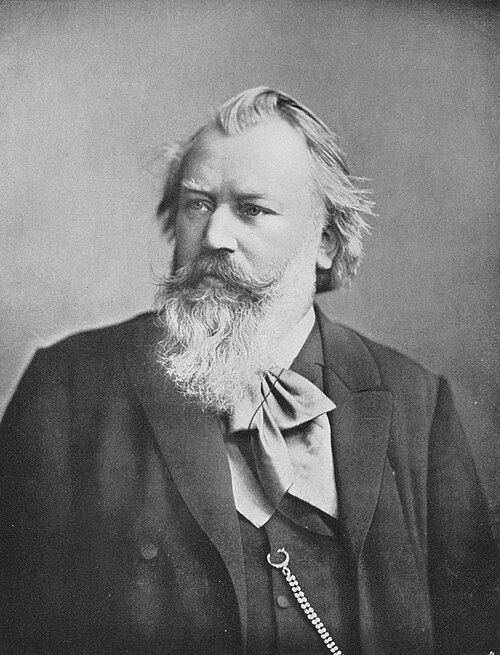
Composer
Johannes Brahms
1833–1897
4,957 works in the index
- Born
- 1833
- Died
- 1897
- Birthplace
- Hamburg
- Citizenship / historical state
- Hamburg
- Period (estimated from birth year)
- Romantic
Biography
Brahms wrote densely and revised ruthlessly, destroying what did not satisfy him, so the surviving catalogue is smaller than his contemporaries' and uniformly serious. It covers symphonies, concerti, a large body of chamber music, songs and late piano pieces.
For pianists the late Op. 116–119 pieces are the heart of it — short, inward and technically less punishing than the earlier sonatas, though musically demanding. The Hungarian Dances in their four-hand form are the most-played thing he wrote and are genuinely approachable. Singers have over two hundred songs and the German Requiem.
His piano writing assumes a large hand and comfortable tenths appear regularly. Editions differ little; what varies is fingering, and an edition with good fingering is worth paying for here.
In this catalogue
- Common listed instruments
- Piano, Voice, Choir, Low Voice, Orchestra
- Genres represented
- Classical, Jazz, pop, Pop, Christmas
- Works with composition dates
- 255 of 4,957
These details describe the indexed sheet music, including arrangements.
Catalogue
Works page 41 of 104
Years are composition dates where known. Instruments describe editions in our catalogue and may include arrangements. A dash means the detail is not recorded.
| Work | Year composed | Catalogue / opus | Key in title | Listed instruments | Genre | Editions |
|---|---|---|---|---|---|---|
| Opus 65 #4 - Ihr schwarzen Augen | — | Opus 65 | — | Piano, Voice, Choir | Classical | 2 |
| Opus 65 #14 - Flammenauge, dunkles Haar | — | Opus 65 | — | Piano, Voice, Choir | Classical | 2 |
| O die Frauen, Op. 52 no. 3 (O the Ladies) - A-Dur/A major | — | Op. 52 no. 3 | — | Choir | Classical | 1 |
| O die Frauen (Appendix), Op. 52 no. 3 (O the Ladies) - B-Dur/B-flat major | — | Op. 52 no. 3 | — | Choir | Classical | 1 |
| Schlosser, auf, und mache Schlosser, Op. 52 no. 12 (Locksmith, up, and make your locks) - Es-Dur/Eb major | — | Op. 52 no. 12 | — | bass, Tenor, Choir, Alto | Classical | 1 |
| Der Englische Gruss | — | — | — | Voice, Tenor, Alto, A Cappella | Classical | 1 |
| Marias Kirchgang | — | — | — | Voice, A Cappella | Classical | 1 |
| Marias Lob | — | — | — | Voice, Tenor, Alto, A Cappella | Classical | 0 |
| The Fiddler | — | — | — | Tuba, A Cappella | Classical | 2 |
| A House Stands 'neath The Willows' Shade | — | — | — | Tuba, A Cappella | Classical | 2 |
| Dein Herzlein mild | — | — | — | A Cappella | Classical | 1 |
| Beherzigung | — | — | — | A Cappella | Classical | 1 |
| Es geht ein Wehen | — | — | — | A Cappella | Classical | 1 |
| Waldesnacht | — | — | — | A Cappella | Classical | 1 |
| Waltz Op 39 No 15 | 1865Wikidata | Op 39 No 15 | — | Piano, Organ | — | 2 |
| Liebestreu: O versenk' versenk' dein Leid, mein Kind | — | — | — | Voice High, Low Voice | Classical | 1 |
| Heimweh II: O wusst ich doch den Weg zuruck | — | — | — | Voice, Voice High, Low Voice | Classical | 1 |
| An die Nachtigall: Geuss nicht so laut der liebentflammten Lieder | — | — | — | Voice High, Low Voice | Classical | 1 |
| Die Mainacht: Wann der silberne Mond | — | — | — | Voice High, Low Voice | Classical | 1 |
| Denn es gehet dem Menschen, wie dem Vieh | — | — | — | Low Voice | Classical | 2 |
| Alte Liebe: Es kehrt di dunkle Schwalbe, op. 72, no. 1 | — | op. 72, no. 1 | — | Low Voice | Classical | 1 |
| Der Tod ist verschlungen in den Sieg | — | — | — | Choir, Voice Tenor | Classical | 2 |
| Siciliana | — | — | — | Piano | — | 1 |
| Song of India | — | — | — | Piano | Classical | 2 |
| Capriccio In F# Minor, Op.76 | — | Op.76 | F-sharp minor | Piano | Classical | 3 |
| Capriccio In C# Minor, Op.76 | — | Op.76 | C-sharp minor | Piano | Classical | 3 |
| Variations & Fugue On A Theme By Handel, Op.24 | — | Op.24 | — | Piano | Classical | 2 |
| Major Tonic Chord Arpeggios | — | — | — | Piano | Classical | 1 |
| Minor Tonic Chord Arpeggios | — | — | — | Piano | Classical | 1 |
| Brahms: Ballad B major op. 10,4 | — | op. 10 | — | Piano, harpsichord | Classical | 1 |
| Brahms: Scherzo e flat minor op. 4 | — | op. 4 | — | Piano, harpsichord | Classical | 0 |
| Brahms: Ballad [Edward-Ballad] d minor op. 10,1 | — | op. 10 | — | Piano, harpsichord | Classical | 1 |
| Opus 76 #5 - Capriccio | — | Opus 76 | — | Piano | Classical | 1 |
| Opus 116 #6 - Intermezzo | — | Opus 116 | — | Piano | Classical | 1 |
| Opus 119 #1 - Intermezzo | — | Opus 119 | — | Piano | Classical | 1 |
| Studies - #4 Presto Nach J.S. Bach (II. Bearbeitung) | — | — | — | Piano | Classical | 1 |
| Concerto No. 1 in D Minor | — | — | D minor | Piano | Classical | 1 |
| Gigue No.1 | — | — | — | Piano | Classical | 2 |
| Presto #2 After Bach | — | — | — | Piano | Classical | 3 |
| Intermzzo in A Minor, Op. 76, No. 7 | — | Op. 76, No. 7 | A minor | Piano | Classical | 2 |
| Study No. 4 after Bach's BWV 1001 (Second Version) | — | BWV 1001 | — | Piano | Classical | 1 |
| Cadenza for Mozart's Piano Concerto in D Minor, K. 466 | — | K. 466 | D minor | Piano | Classical | 2 |
| Brahms: Schumann-Variations op. 9 | — | op. 9 | — | Piano | Classical | 1 |
| Rhapsody B Min Op79#1(Pno)brahms | — | Op79 | — | Piano | Classical | 1 |
| Heidenr?slein | — | — | — | Piano, Voice | Classical | 1 |
| Beim Ritt auf dem Knie | — | — | — | Piano, Voice | Classical | 1 |
| Marienw?rmchen | — | — | — | Piano, Voice, Low Voice | Classical | 0 |
| Brahms: Capriccio C major op. 76,8 | — | op. 76 | — | Piano | Classical | 1 |
Biographical record: Wikidata, matched on name and checked against dates held in the catalogue. The period label is an estimate from birth year. The biography above is our own. Authority record: VIAF 7573295. Portrait: C. Brasch , Berlin ( biography ), Public domain, via Wikimedia Commons.