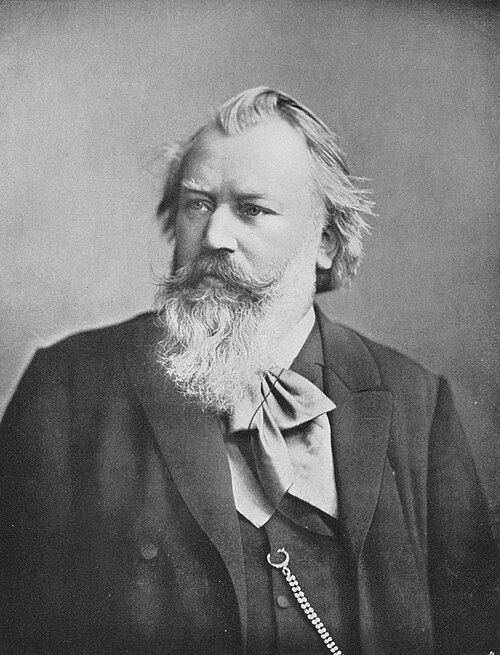
Composer
Johannes Brahms
1833–1897
4,957 works in the index
- Born
- 1833
- Died
- 1897
- Birthplace
- Hamburg
- Citizenship / historical state
- Hamburg
- Period (estimated from birth year)
- Romantic
Biography
Brahms wrote densely and revised ruthlessly, destroying what did not satisfy him, so the surviving catalogue is smaller than his contemporaries' and uniformly serious. It covers symphonies, concerti, a large body of chamber music, songs and late piano pieces.
For pianists the late Op. 116–119 pieces are the heart of it — short, inward and technically less punishing than the earlier sonatas, though musically demanding. The Hungarian Dances in their four-hand form are the most-played thing he wrote and are genuinely approachable. Singers have over two hundred songs and the German Requiem.
His piano writing assumes a large hand and comfortable tenths appear regularly. Editions differ little; what varies is fingering, and an edition with good fingering is worth paying for here.
In this catalogue
- Common listed instruments
- Piano, Voice, Choir, Low Voice, Orchestra
- Genres represented
- Classical, Jazz, pop, Pop, Christmas
- Works with composition dates
- 255 of 4,957
These details describe the indexed sheet music, including arrangements.
Catalogue
Works page 7 of 104
Years are composition dates where known. Instruments describe editions in our catalogue and may include arrangements. A dash means the detail is not recorded.
| Work | Year composed | Catalogue / opus | Key in title | Listed instruments | Genre | Editions |
|---|---|---|---|---|---|---|
| 6 Songs, Op. 6 - 1. Spanisches Lied | — | Op. 6 | — | — | Classical | 8 |
| 6 Songs, Op. 6 - 4. Juchhe! | — | Op. 6 | — | — | Classical | 8 |
| Songs and Romances, Op. 14 - 2. Vom verwundten Knaben | 1858IMSLP | Op. 14 | — | — | Classical | 8 |
| Songs and Romances, Op. 14 - 4. Ein Sonett | 1858IMSLP | Op. 14 | — | — | Classical | 8 |
| 5 Poems, Op. 19 - 1. Der Kuss | — | Op. 19 | — | — | Classical | 7 |
| 9 Songs, Op. 32 - 1. Wie rafft ich mich auf in der Nacht | — | Op. 32 | — | — | Classical | 8 |
| 9 Songs, Op. 32 - 6. Du sprichst, dass ich mich tauschte | — | Op. 32 | — | — | Classical | 8 |
| A German Requiem , Op. 45 - 2. Behold, all flesh is as the grass Performed by Johannes Brahms | 1865–68IMSLP | Op. 45 | — | Voice, Choir | Classical | 7 |
| A German Requiem , Op. 45 - 5. Ye now are sorrowful Performed by Johannes Brahms | 1865–68IMSLP | Op. 45 | — | Voice, Choir | Classical | 7 |
| A German Requiem , Op. 45 - 7. Blessed are the dead which die in the Lord Performed by Johannes Brahms | 1865–68IMSLP | Op. 45 | — | Voice, Choir | Classical | 7 |
| Piano Concerto No. 2 in Bb Major, Op. 83 - Third Movement | — | Op. 83 | B-flat major | — | Classical | 8 |
| Red And White The Roses | — | — | — | Piano | Classical | 6 |
| Behold, A Rose Is Blooming | — | — | — | Organ | Classical | 6 |
| Tambourliedchen Op.69 No. 5 - Score | — | Op.69 No. 5 | — | Piano | Classical | 7 |
| Meine Liebe ist grün Op.63 No. 5 - Score | — | Op.63 No. 5 | — | Piano | Classical | 7 |
| Dort in den Weiden Op.97 No. 4 - Score | — | Op.97 No. 4 | — | Piano | Classical | 7 |
| Tambourliedchen Op.69 No. 5 | — | Op.69 No. 5 | — | Piano | — | 0 |
| Dort in den Weiden Op.97 No. 4 | — | Op.97 No. 4 | — | Piano | — | 0 |
| Hungarian Dances for piano, 4 hands, WoO 1, Book 4, No. 21 in E minor: Vivace | — | WoO 1 | E minor | Piano | Classical | 6 |
| 8 Lieder and Songs | 1871 ca.IMSLP | — | — | voice piano | Classical | 6 |
| 5 Romances and Songs | 1881–82 ca.IMSLP | — | — | — | Classical | 6 |
| 4 Songs | 1860IMSLP | — | — | Harp, voice piano, Horn | Classical | 6 |
| Symphony No.1 | 1862–76IMSLP | — | — | Oboe, violin, Horn, Trombone, Timpani, Tuba, Piccolo, Contrabassoon | Classical | 6 |
| Violin Sonata No.1 | 1878–79IMSLP | — | — | Piano, violin | Classical | 5 |
| Hungarian Dance No. 5: Flute Quarte | — | — | — | — | — | 5 |
| Hungarian Dance No. 5: Piano Sol | — | — | — | — | — | 6 |
| Meine Liebe Ist Grun | — | — | — | Voice, Voice High, Low Voice | Classical | 9 |
| Der Tod, Das Ist Die Kuhle Nacht | — | — | — | Piano, Voice, Voice High, Low Voice | Classical | 6 |
| 10. Blinde Kuh | — | — | — | Voice, Voice High, Low Voice | Classical | 11 |
| 34. Nachtigall | — | — | — | Piano, Voice High, Low Voice | Classical | 13 |
| 40. O wusst' ich doch den Weg | — | — | — | Voice | Classical | 9 |
| Sehnsucht (Longings) | — | — | — | Piano, Voice, bass, Tenor, Alto, Voice High, Low Voice | Classical | 8 |
| Vergebliches St?ndchen | — | — | — | Piano, Low Voice | Classical | 6 |
| Symphony No. 4 In E Minor : Movement IV | — | — | E minor | Piano, Orchestra | Classical | 6 |
| St Anthony Chorale | — | — | — | Piano | — | 6 |
| Mond verhullt(Brahms-Zigeunerlieder) | — | — | — | Voice, Choir | Classical | 6 |
| Nachtwache (I) | — | — | — | A Cappella | Classical | 4 |
| Wie Melodien | — | — | — | Piano, Organ | Classical | 6 |
| Ballade Op 118 No 3 | — | Op 118 No 3 | — | Piano | Classical | 7 |
| Wiusst ihr, wann mein Kindchen am allerschonsten ist? | — | — | — | Voice High, Low Voice | Classical | 6 |
| Brauner Bursche fuhrt zum Tanze | — | — | — | Piano, Organ, Choir, Voice High, Low Voice | Classical | 3 |
| Rote Abendwolken ziehn am Firmament | — | — | — | Piano, Organ, bass, Tenor, Choir, Alto, Voice High, Low Voice | Classical | 6 |
| Funeral March of a Marionette | — | — | — | Piano | — | 6 |
| Ballade In B, Op.10 | — | Op.10 | — | Piano | Classical | 7 |
| Romance, F major, op. 118,5 (Piano solo) | — | op. 118 | — | Piano, harpsichord | Classical | 6 |
| Certificate | — | — | — | Piano | Classical | 6 |
| Rhapsody, G minor, op. 79,2 (Piano solo) | — | op. 79 | — | Piano | Classical | 6 |
| Opus 116 #3 - Capriccio | — | Opus 116 | — | Piano | Classical | 6 |
Biographical record: Wikidata, matched on name and checked against dates held in the catalogue. The period label is an estimate from birth year. The biography above is our own. Authority record: VIAF 7573295. Portrait: C. Brasch , Berlin ( biography ), Public domain, via Wikimedia Commons.